

Journal Entry: Examples, Types, Common Mistakes, and FAQs

Small errors can lead to significant discrepancies in your financial statements. Double-check all numbers, dates, and descriptions before finalizing your entries. It ensures that your financial statements reflect the true state of your business, giving you an accurate representation of its profitability, liquidity, and stability. With precise reporting, you can confidently analyze trends, identify potential risks or opportunities, and make strategic decisions to drive growth.
Expense journal

For example, one accountant might name an account Notes Payable and another might call it Loans Payable. Both account titles refer to the amounts borrowed by the company. The account title should be logical to help the accountant group similar transactions ledger account into the same account. Once you give an account a title, you must use that same title throughout the accounting records. Other purchases related to transactions in Company Material Ltd. are given below.

Navigating Business Expenses: A Comprehensive Guide for Business Owners and Accountants

Put simply, in journal entries for double-entry bookkeeping, we differentiate between debits and credits based on how they impact different types of accounts. Recording transactions in accounting is considered the fundamental step in the accounting process, where all transaction details are entered into their respective books. Transactions are events or conditions that are recorded in the business books as they affect the business’s financial condition. They are agreements made between buyers and sellers based on the items (goods or services) transferred. They are a business occurrence that has monetary effects on the company’s financial records. Adjusting entries are used to update previously recorded journal entries.
- You’re going to meet up with a client, pick up some office supplies, and stop by the bank to make a loan payment.
- Every business has a Cash account in its accounting system because knowledge of the amount of cash on hand is useful information.
- In single-entry accounting, every transaction is journalized as a single transaction.
- A journal entry is the recording of a business transaction in the journal.
Step 3 – Apply The Basic Accounting Equation To The Transactions
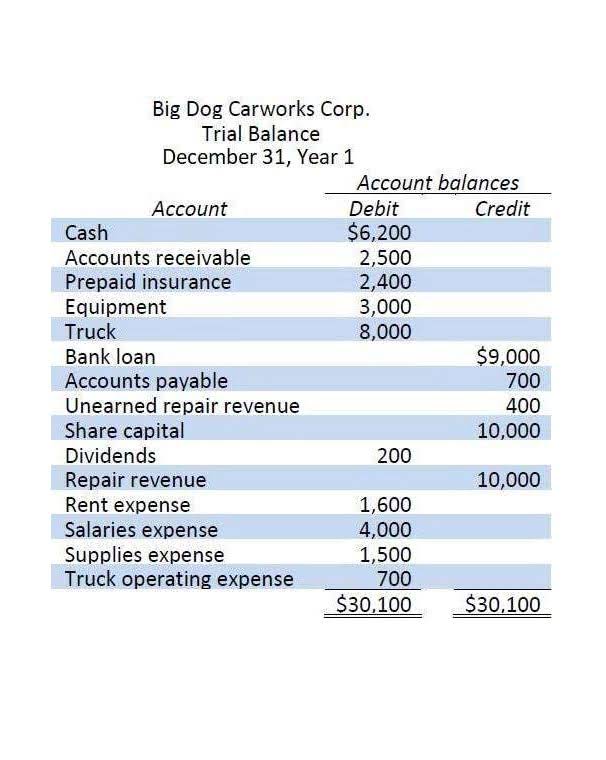
The second step is recording them in their specific accounts and into the debit and credit columns. As you might’ve guessed, recording transactions in a journal a journal entry for sales of goods, is created whenever your business sells some manufactured goods. Since these are self-descriptive enough, let’s move on to some more complex accounting journal entries.

AccountingTools
Let’s look at a https://www.bookstime.com/ payment of $1,000 with $800 going towards the loan balance and $200 being interest expense. This happens when the debit or credit amount is made up of multiple lines. On the way back from meeting with your client, you stopped to pick up $100 worth of office supplies. Financial statements are the key to tracking your business performance and accurately filing your taxes. They let you see, at a glance, how your business is performing. Our intuitive software automates the busywork with powerful tools and features designed to help you simplify your financial management and make informed business decisions.
To make their thingamajigs Jane purchased $4000 in thingamajig materials on credit for cost of goods. On 31 May 2018, ABC Co. paid $3,500 in cash to its landlord for the next month’s rent (for June rental). You have the following transactions the last few days ofApril. If you are not yet familiar with the accounting elements and how each they work, see our lesson about Fundamental Accounting Concepts here. Explore expert insights, tips, and updates in finance and accounting at Our Accounting World—your go-to resource for all things accounting.
- The ledger organizes the account balances, and posting ensures that the accounts are updated with the transaction’s effects.
- These entries are called journal entries (since they are entries into journals).
- Now, our business owner wants to withdraw some cash from the business for personal use.
- In a journal entry, you record the details of the transaction, while in a ledger entry, you summarize and organize them.
- For example, on 28 May 2018, ABC Co. made cash sales of $1,200 which its total cost was $700.
- Remember, like yin and yang, debits and credits work together in perfect harmony to maintain balance.
- This makes it easier to prepare accurate financial reports, comply with accounting standards, and generate financial statements.
- Right now, our Supplies account says we have $3,300 worth of supplies in the supply closet, but this is no longer accurate.
- Recording business transactions in the general journal using journal entries is the second step in the accounting cycle of the business.
- It’s important to be aware of the common mistakes when it comes to journal entries and take steps to avoid errors.
- This is similar to the posting process of using a combination journal.
- When we say the opposite, we don’t mean that the adjusting entries get deleted.
Balancing debits and credits is crucial in order to maintain a balanced accounting equation. It is important to understand the impact of debits and credits when recording journal entries. By understanding these principles of debits and credits in both income statements and balance sheets, you can gain greater control over your financial records. In the balance sheet, debits and credits have different implications. Debits increase asset accounts like cash or inventory, while credits decrease them. On the other hand, liabilities and equity are affected differently – debits decrease those accounts, while credits increase them.